BambooHR vs Lever vs Greenhouse: The Hidden Costs Nobody Shows You (2026)
Updated: Apr 29
What Greenhouse, BambooHR, and Lever Actually Charge, And What They Hope You Never Calculate
The pricing playbook your vendor doesn't want you to read.
You have been through this. Your company hits 80 employees. Your spreadsheets are on fire. Your recruiter is toggling between seven browser tabs and an ATS that was built when the iPhone 5 was cutting-edge. So you start shopping.
You click “Get a Demo” on three vendor websites. Within 48 hours, you are buried in discovery calls, ROI calculators nobody asked for, and a sales rep who wants to know your funding round before quoting a number. Two weeks later, you have three proposals, none of them comparable, and a creeping suspicion that the price you were quoted has very little to do with the cost you will actually pay.
This is not an accident. It is the business model.

The legacy HR tech market, dominated by platforms like Greenhouse, BambooHR, and Lever, is built on pricing opacity, feature gating, and escalation clauses buried in renewal contracts. These companies have spent a decade perfecting a sales motion designed to get you locked in before you understand the total cost of ownership.
We know this because we lived it. HC-Resource is a recruiting firm that places over 150 people a month. We have been a paying customer of these tools. We have sat through the demos, signed the contracts, and opened the renewal invoices that made us question our life choices.
Eventually, we stopped complaining and built our own platform.

This report is not a hit piece. It is an operator’s field guide. We pulled 2026 procurement data, buyer-reported contracts, G2 and Capterra reviews, and third-party spend analysis to give you the numbers these vendors will not put on their websites.
If you are evaluating HR software this year, what follows could save you tens of thousands of dollars, or at the very least, arm you for the negotiation you did not know you needed.
The Psychology of “Contact Us for Pricing”
Before we break down each vendor, it is worth understanding why the pricing model works the way it does. Greenhouse, Lever, and, to a large extent, BambooHR all use some form of custom, quote-based pricing. There is a reason none of them put a number on their homepage, and it is not because every company’s needs are unique.
Sunk-Cost Manipulation
By the time you receive a quote, you have already invested 4 to 8 hours across discovery calls, demo sessions, and internal alignment meetings. Your team has seen the product. Your VP of People is excited. Walking away at that point feels like wasted effort.
That is exactly the dynamic the vendor is counting on. The longer the sales cycle, the less likely you are to push back on price.
Value-Based Extraction
When a sales rep asks about your headcount, your hiring volume, and your funding stage, they are not doing needs analysis. They are building a price anchor. Companies that have raised a Series B get quoted differently than bootstrapped companies with identical feature needs.
The price is based on what you can afford, not what the software costs to deliver.
Comparison Prevention
If you cannot see a price, you cannot comparison-shop. If every vendor gives you a custom quote after a multi-week process, you are less likely to run the numbers side by side. This is by design. The moment buyers can compare prices transparently, the vendors with the highest margins lose.
The question is not “How much does the subscription cost?” It is “How much does everything cost in the first year, the second year, and the third year?”
Greenhouse: The Headcount Tax
Greenhouse positions itself as the premium ATS for mid-market and enterprise companies. The product is capable. The workflows are mature. The integration ecosystem is extensive. None of that is the problem. The problem is how they charge for it.
How the Pricing Actually Works
Greenhouse uses a custom, quote-based model where the price scales by total company headcount, not the number of recruiters using the platform, and not the number of hires you make. If your company has 300 employees but only 4 people log into Greenhouse, you are still paying for 300.
Company Size | Estimated Annual Cost | Per-Employee Effective Rate |
Under 50 employees | $5,000 – $6,500 | $100 – $130/employee |
50 – 250 employees | $10,000 – $20,000 | $40 – $200/employee |
250 – 1,000 employees | $20,000 – $40,000 | $20 – $80/employee |
1,000+ employees | $40,000 – $70,000+ | $40 – $70/employee |
Source: 2026 procurement data and buyer-reported contracts
The Hidden Costs That Add Up
➜ Implementation fees. Greenhouse charges professional services fees to configure workflows, build integrations, and migrate data. Basic setups start around $2,000, but multi-system integrations routinely push implementation costs to $10,000 or more. This is a one-time charge that does not appear in the subscription quote.
➜ Renewal escalation. Buyer reports and procurement benchmarks consistently show Greenhouse applying 8 to 15 percent annual price increases at renewal for the exact same product. Vendr’s 2026 data confirms that contracts often include escalation clauses of 3 to 7 percent, and buyers who do not negotiate a cap see significantly higher jumps. A $18,000 first-year contract can quietly become $21,000 by year two.
➜ Feature gating. The base tier is an empty shell. Sourcing automation, CRM capabilities, advanced analytics, and onboarding modules are sold as separate add-ons. Users frequently report buying third-party tools to fill gaps that the base subscription does not cover.
➜ Integration tools. Standard connectors are included, but custom API work for niche payroll, background check, or HRIS systems typically runs $1,000 to $5,000 per integration.
What Operators Actually Experience
Greenhouse implementations typically take one to three months to go fully live. The backend is complex enough that most mid-market companies end up dedicating a full-time administrator just to manage permissions, reporting, and workflow configuration. That is an operational cost that never appears on the invoice.
BambooHR: The Small Business Penalty
BambooHR markets itself as the friendly, approachable HRIS for growing companies. The user interface is genuinely well-designed. The onboarding experience is polished. And the per-employee pricing model looks reasonable, until your company starts actually growing.
How the Pricing Actually Works
BambooHR charges per employee per month across three tiers. The company restructured from two tiers to three in 2024, adding an Elite tier and moving several previously included features behind higher paywalls. Exact pricing is not published, but third-party buyer reports are consistent.
Tier | Per Employee/Month | 50-Employee Annual | 200-Employee Annual |
Core | ~$10 | $6,000 | $24,000 |
Pro | ~$17 | $10,200 | $40,800 |
Elite | ~$25 | $15,000 | $60,000 |
Source: 2026 third-party buyer reports and procurement analysis
The Growth Penalty
➜ The $250 monthly floor. BambooHR enforces a minimum monthly fee of $250 regardless of company size. A startup with 5 employees is effectively paying $50 per person per month for HRIS software. That is enterprise pricing for a seed-stage company.
➜ Linear cost scaling. Because pricing is per-employee, every single hire increases your software bill. A 40-person company on the Pro plan paying $640 per month becomes a 60-person company paying $960 per month six months later. Growth is expensive enough without your HR software taxing every headcount addition.
➜ Add-on stacking. Payroll processing, benefits administration, time tracking, and the applicant tracking module are all priced separately and layered on top of the base tier. A 50-person company running the full BambooHR suite can easily reach $18,000 to $20,000 per year, and that is before renewal increases.
➜ Renewal surprises. Multiple G2 reviewers and buyer communities report renewal price hikes of 15 to 30 percent. Some long-term customers reported being moved to lower-tier plans during the 2024 restructuring, losing access to features they had previously been paying for.
The ATS That Isn’t Really an ATS
BambooHR’s built-in applicant tracking module is the most revealing weakness. The Core plan caps users at 5 active job openings. Even the Elite plan caps at 50. There is zero proactive recruiting capability, no sourcing tools, no automated outreach sequences, and no candidate relationship management.
For companies hiring more than 20 roles per year, BambooHR’s ATS is not a solution. It is a checkbox. Most mid-market companies that use BambooHR end up buying a separate ATS anyway, paying two vendors, logging into two dashboards, and re-entering candidate data the moment someone accepts an offer.
Two systems, two logins, two invoices, zero data continuity. That is the actual cost of BambooHR for any company that takes hiring seriously.
Lever: The Opaque Bundle
Lever, now part of Employ Inc. alongside JazzHR and Jobvite, positions itself as the combined ATS and CRM for relationship-driven recruiting. The product is capable. The CRM layer is genuinely differentiated from pure ATS competitors. But the pricing model is one of the most opaque in the industry.
How the Pricing Actually Works
Lever does not publish any pricing. Contracts are structured as annual commitments based on highly customized bundles. Procurement data from Vendr and third-party buyer analysis paint a consistent picture.
Company Size | Estimated Annual Cost | Notes |
Small teams (<50) | $6,000 – $8,000 | Restricted feature set |
Mid-market (50–500) | $15,000 – $60,000 | Price varies 3–4x at the same size |
Enterprise (500+) | $60,000 – $144,000+ | Add-ons can double base |
Source: Vendr 2026 transaction data and buyer-reported contracts
Where the Money Hides
➜ Unpredictable scaling. Because pricing is hidden and custom, companies cannot forecast their HR tech spend. A 200-employee company might be quoted anywhere from $14,400 to $19,200 per year depending on who answered the discovery call and what quarter it is.
Vendr’s 2026 data shows the median negotiated contract for a 200-person company is $12,240, but the initial list price is $19,185. That is a 36 percent markup that disappears only if you push back.
➜ Implementation fees. Lever quotes $3,000 to $15,000 for implementation services. Some enterprise contracts see quotes of $15,000 to $25,000. Data migration adds another $3,000 to $8,000 depending on the volume and complexity of your historical candidate database.
➜ Renewal escalation. Customer reviews on G2 and Capterra consistently report renewal increases of 8 to 12 percent annually. Over a three-year period, a $15,000 contract can reach $18,000 to $20,000 without any new features or additional users.
➜ Add-on creep. Advanced analytics, nurture automation, EU data center hosting, and sandbox environments are all priced separately. For a 500-employee company, analytics alone can add $9,000 to $16,000 per year.
What Operators Actually Experience
Lever’s implementation timelines stretch weeks into months. Once the system is live, a recurring theme in buyer feedback is that proactive customer support disappears. The platform works, but the post-sale relationship often does not match the pre-sale experience.
And here is the fundamental gap: Lever is ATS-only. There is no HRIS.
No employee records after the offer letter. No onboarding portal. No PTO tracking. No performance management. No compliance module. Every Lever customer still needs a separate HRIS, which means two vendors, two contracts, two data models, and a manual handoff every time a candidate becomes an employee.
The Total Cost of Ownership Nobody Shows You
Vendors quote subscription prices. Operators pay the total cost of ownership. Here is what a 200-employee company actually spends over three years with each platform, including implementation, add-ons, and documented renewal escalation.
Cost Category | Greenhouse | BambooHR + ATS | Lever + HRIS | HC-Core |
Year 1 Subscription | $18,000 | $20,400 | $26,400 | $10,200 |
Implementation | $5,000 | $2,000 | $8,000 | $0 |
Add-Ons / Second Tool | $6,000 | $8,000 | $10,000 | $0 |
Year 2 (w/ Renewal Hike) | $20,700 | $24,480 | $29,040 | $10,200 |
Year 3 (w/ Renewal Hike) | $23,800 | $29,380 | $31,960 | $10,200 |
3-YEAR TOTAL | $73,500 | $84,260 | $105,400 | $30,600 |
Estimates based on 200-employee company. BambooHR Pro + standalone ATS. Lever mid-tier + separate HRIS. Greenhouse mid-market tier. HC-Core ATS+HRIS Core tier at published pricing. Renewal hikes modeled at 15% for BambooHR, 10% for Lever/Greenhouse per buyer reports.

The gap is not marginal. Over three years, a 200-employee company can spend $43,000 to $75,000 more on a legacy two-tool stack than on a unified platform. That is real money.
For a mid-market company, it is the difference between hiring another recruiter or paying a software tax to vendors who raise prices every twelve months.
What a Transparent Alternative Actually Looks Like
We built HC-Core because we got tired of being on the wrong side of every dynamic described in this report. We were the 200-employee company paying two vendors. We were the team re-entering candidate data into a separate HRIS the day someone accepted an offer. We were the operators reading renewal invoices with numbers we never agreed to.
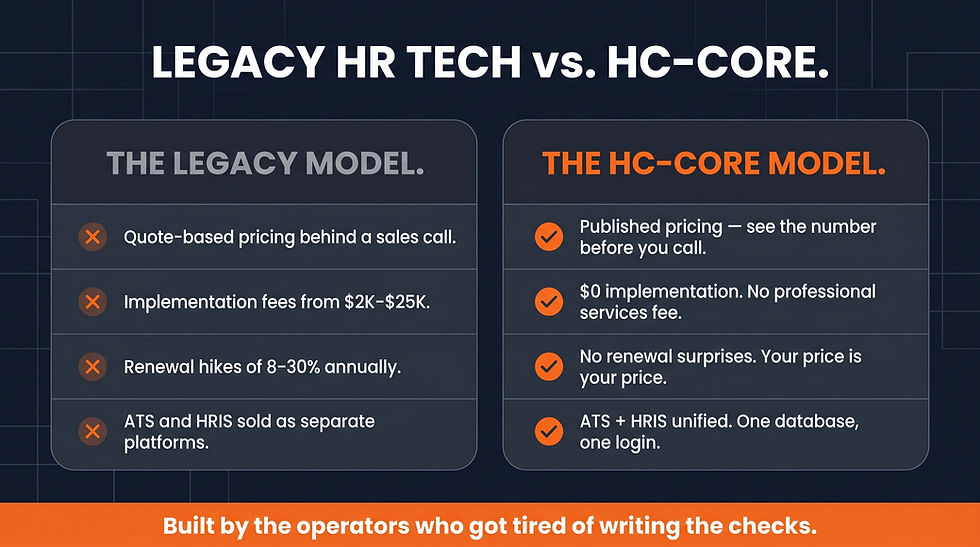
HC-Core is a unified ATS and HRIS ➜ one platform, one database, one login, one bill. A candidate becomes an employee without re-entry. An employee’s full lifecycle lives in one record from the moment they apply to the day they leave. Here is what we do differently.
➜ Published pricing with no surprises. ATS starts at $99 per month. ATS plus HRIS starts at $850 per month for up to 50 employees. No per-seat fees. No per-candidate fees. No implementation tax. No 12-month contract required. The number on the website is the number on the invoice.
➜ No renewal extortion. We do not apply 8 to 30 percent annual hikes to existing customers. Your renewal price is your renewal price.
➜ One data model. Greenhouse has no HRIS. Lever has no HRIS. BambooHR’s ATS is a bolt-on that caps at 50 jobs. HC-Core is the only mid-market platform where hire-to-retire is one record, a single person's table with a lifecycle status, not two databases pretending to talk to each other.
➜ Operator-built. HC-Core was built inside HC-Resource, a recruiting firm that places over 150 people a month. Every workflow exists because a recruiter or HR operator needed it, not because a product manager read a Gartner report.
➜ Time-to-value in days, not months. No three-month implementation. No dedicated admin required. No professional services invoice. You sign up, import your data, and start hiring.
The duct tape between your ATS and your HRIS is costing you a full headcount. We cut the tape.
If you are evaluating HR software in 2026, do the math before you sign. Add up the subscription, the implementation fees, the add-ons, the second tool you will need, and three years of renewal increases.
Compare that number to what a unified platform costs when the pricing is published and the vendor does not raise rates on existing customers.
Then decide who you want to write the check to.
Ready to see the difference?
Book a demo at app.hc-resource.com or join our live webinar on May 25, 2026, at 1:00 PM CT. See a real product running a real recruiting business, not a slide deck.


